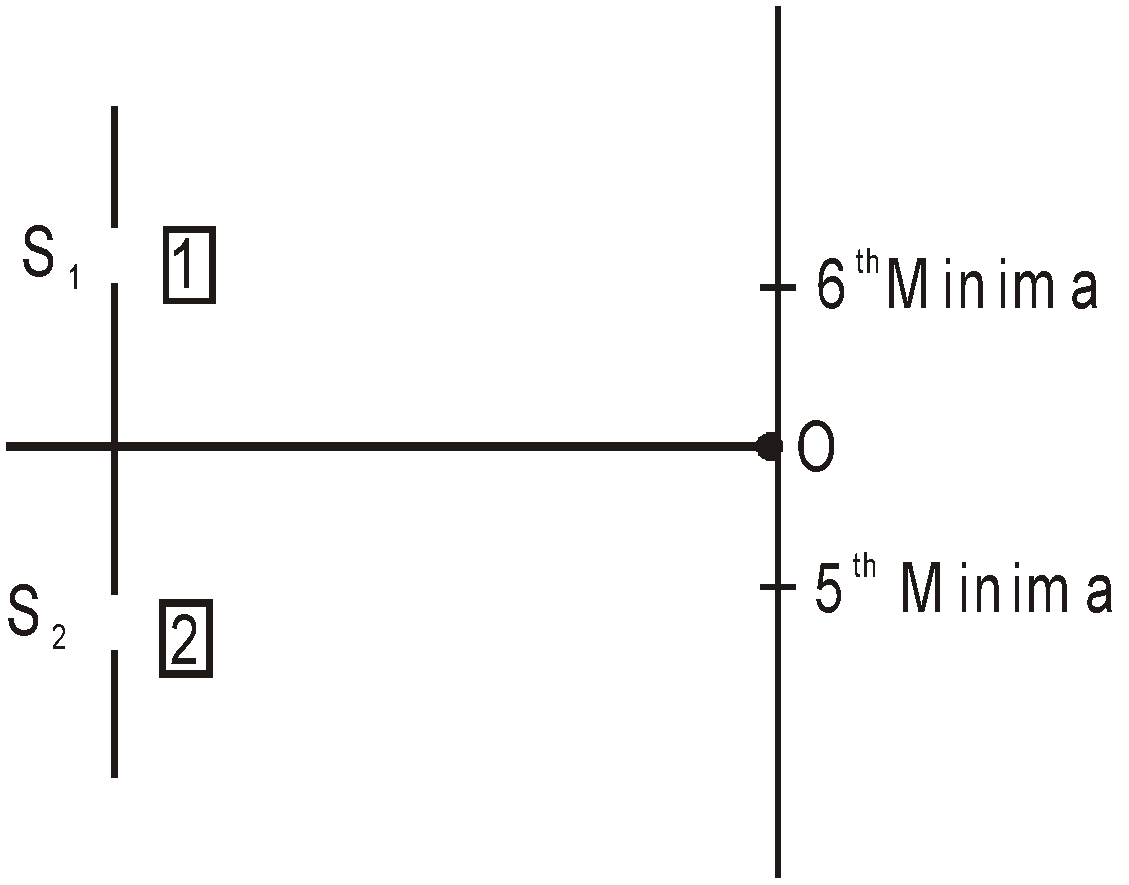
In a Young's experiment, the upper slit is covered by a thin glass plate of refractive index 1.4 while the lower slit is covered by another glass plate having the same thickness as the first one but having refractive index 1.7. Interference pattern is observed using light of wavelength 5400 Å. It is found that the point P on the screen where the central maximum fell before the glass plates were inserted now has (3/4) th the original intensity. It is further observed that what used to be the 5th maximum earlier, lies below the point O while the 6th minimum lies above O. The thickness of the glass plate is n × 10 –7 m. Find the value of n. (Absorption of light by glass plate may be neglected)
Text Solution
Verified by ExpertsCHECK THE SOLUTION.
(93 )
Sol. μ 1 = 1.4, μ 2 = 1.7 and let t be the thickness of each glass plates.
Path difference at O, due to insertion of glass plates will be -
Δ x = ( μ 2 – μ 1 ) t = ( 1.7 – 1.4 ) t = 0.3 t .......
Now since 5 th maxima ( earlier) lies below O and 6 th minima lies above O.
This path difference should lie between 5 λ and 5 λ + λ /2
So let Δ x = 5 λ + Δ .......
where Δ < λ / 2
Due to the path difference Δ x, the phase difference at O will be
φ =  Δ x =
Δ x =  ( 5 λ + Δ ) = 10 π +
  . Δ ) .......
Intensity at O is given  I max and since
I ( φ ) = I max cos 2 
∴  I max = I max cos 2
or  = cos 2
  .........
From equations and , we find that
Δ = λ / 6
i.e. Δ x = 5 λ + λ / 6 = (31 λ / 6) λ = 0.3 t
∴ t =  =
=  m
m
or t = 9.3 × 10 -6 m = 9.3 μ m
Prepare Smarter with CGP Edu
Get practice questions, solutions, and test series in one place.
Write a Review
Share your experience with this question and solution.
Commentary
Send your comment, doubt, correction, or feedback to admin.
Similar Questions
Explore conceptually related problems